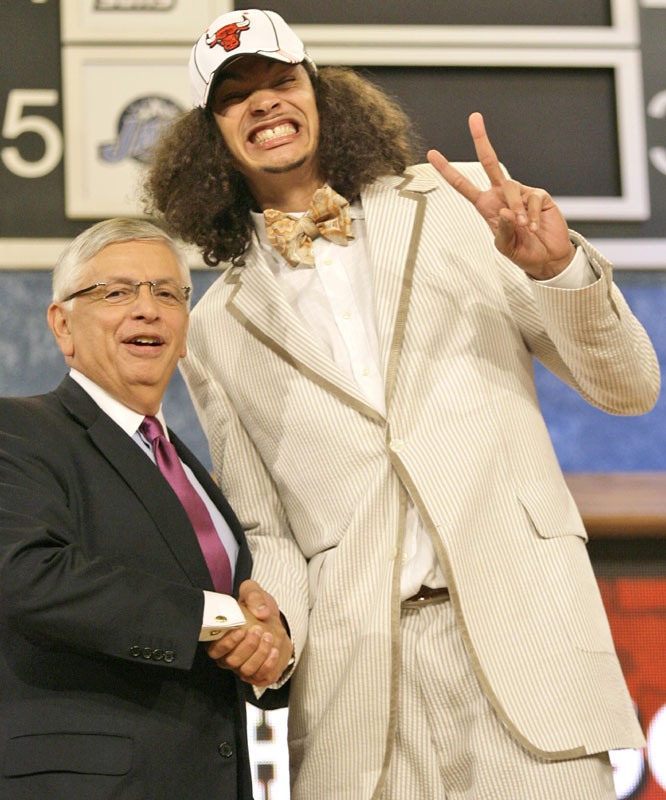
Kobe said that he would take 50 million dollars a year to play for a team like Milan. Earl Boykins just became the highest paid Italian League player ever at 3.5 million dollars per year. Do the math.
According to Alexander Chernykh, writer for the Russian sports site sports.ru, the only teams with money are the two Greek Teams (Panathinaikos, Olympiakos) and the Russian teams (BC Khimki, CSKA Moskow, Dynamo Moscow), and I'm pretty sure that even if Kobe would be willing to go to Italy, he'd be more hesitant about living through a Russian winter.
Showing posts with label eurohoops. Show all posts
Showing posts with label eurohoops. Show all posts
Friday, August 8, 2008
Why Kobe isn't going to Italy


Thursday, August 7, 2008
Solution to the Euro Crisis

Carlos Delfino, JC Navarro, Nenad Krstic, Jorge Garbajosa, Bostjan Nachbar, Primoz Brezec, Josh Childress, Carlos Arroyo, Earl Boykins. This is a supposedly complete list of NBA players that have defected (I love how we just throw around that term like nothing) to Europe this off-season alone. Who's next? Carl Landry? Jason Williams?
We hear playful talk out of Lebron and Kobe saying that if offered 50 million dollars a year, they'd make the jump too. So what are we going to do about this?
Before we enter this discussion, let it be known that I realize it is very hard to change a CBA. Also that any changes outlined wouldn't go into effect until 2012. But here is my idea anyway.
I was thinking aout the David Beckham rule analogy I made when the Childress news broke, and I was wondering what would happen if a similar thing were espoused in the NBA. Let's keep the same basic structure of the current salary cap (Max Contracts, Mid-level exceptions, etc.), except allow for one exemption per team, an Overmax contract.
The basics of the Overmax would be that it is outside the rules of the salary cap. The salary given to this player has no maximum and does not count against your salary cap. This way, we aren't handcuffed by the salary cap and simply outbid by European teams.
Another problem with the current system is how it locks in mid-levelish players into an MLE type contract. Maybe Josh Childress was worth 8 million dollars to some NBA teams, but realistically most teams in the bidding were only going to offer a MLE. With the introduction of the Overmax, your second-tier player now gets between an MLE and a "max" contract.
Obviously, like with any system, there are problems with this. The primary problem behind this is that unlike the MLS, the NBA hinges upon having 3 superstars on your team, abiding by the Pareto Principle. The Overmax contract could lead to the death of the second (and third, for that matter) fiddle.
However, here are the ways around that:
This encourages teams to try to build up via the draft, as they know that after the rookie contract is up, they will be in prime position to offer the Overmax contract, as other teams might already have their hands tied. It does, however, give a lot of power to the player's current team to set their own price without a lot of negotiating power going to the player. But they are still theoretically bidding against Europe, so the player has that on their side.
Another problem with this is that it leads to the death of the small market team. Maybe at the end of the day, the Utah Jazz can only pay Deron Williams 20 million dollars, while he hears offers of 40 from elsewhere. However, in this league, there are more stars than teams (I think, I haven't actually counted), so I'm pretty sure that some stars would have to settle for a normal max contract anyway (*tear*).
I'm sure that there are many more problems that I haven't thought of or outlined here, so I'd appreciate your suggestions. Also, this all makes sense in my head, but if I haven't explained well enough, say so, and I will try harder to explicate more clearly.
Friday, July 25, 2008
No need to panic

While some people might be overreacting to the emigration of Josh Childress (I've actually seen more instances of the opposite reaction), and despite my post yesterday, I don't think we have too too much to worry about yet.
I'd liken this situation to a watered down version of the big signing of David Beckham last year by the LA Galaxy. With the institution of the "Beckham Rule", a lot of people expected at least a few more big names to eschew their European clubs and sign with MLS teams for fat contracts. However, we saw anything but an exodus since then, with the Designated Player Slot only being utilised a total of 8 times since its inception, and mostly on guys like Claudio Reyna and Luciano Emilio: solid players, but by no means stars (kind of like Childress).
The reasoning behind this is that, though all teams are allowed to spend that kind of money on players, only a select few have the money available and want to use it. Sometimes, you play in a small market and just don't have the revenue to justify such a signing. Sometimes, you might not feel comfortable having one player that's worth several times the rest of the team combined. Moreover, on the players side, not everyone would agree to play in an inferior league just for the money, they have pride and their dreams on the line too.
Similarly in Europe, there are only a couple teams that would be able to shell out NBA-sized contracts. The list probably includes Olympiakos, Tel Aviv Maccabee, Benneton Treviso, Tau Ceramica, Real Madrid and CSKA Moscow. Other teams in Europe might have room for one mid-level exception type contract (like the one that Carlos Delfino got from BC Khimki), but those are limited too. So that might amount to a maximum of maybe 15, mostly marginal, NBA players playing overseas at a time? I think we can deal with that.
Hey Ricky, you're so fine
By way of Skeets comes this video of Spain PG, 17-year-old Ricky Rubio getting flashy against international powerhuse, Lithuania. Enjoy:
I've had a lovefest for Ricky for a while now, ever since he put up 2 triple doubles and a quadruple double during the U16 European Championship, including this ridiculous line in the final: 51 points, 24 rebounds, 12 assists, 7 steals. Half of that probably would have qualified for a Whoa Boy.
[edit] I also love how even on his national team jersey, he only writes his first name.
Thursday, July 24, 2008
What the Hair?
In case you haven't noticed this yet, here are the two biggest Americans to leave for Europe this off season.
Brandon Jennings:
Josh Childress:
That's a coincidence, right? Right? Who's next, Joakim Noah? Ronny Turiaf? Birdman??? (Note the first two already have connections with Europe and no one seems to want the Bird here, so why not play overseas?)


Let the gates open
It's official, Josh Childress has left for Olympiakos (Former team of Gerry McNamara) with a 3-year, 32 million dollar contract in his pocket.
You read that correctly, Josh Childress will be making over 10 million dollars a year during a shorter season with possibly more endorsement opportunities and lower tax rates. Were the Hawks offering even close to that kind of money? We were already scared that he'd bolt when the rumors were at 20 million.
Yes, Childress is one-of-a-kind in that he's smart, worldly, and the kind of player that will fit right into the European game. But don't tell me that if a European club is offering twice as much money as the next highest bidder from the NBA, a player will think more than twice about culture shock. You see the green and you make the necessary adjustments in your life. Also, it's probably just as much of a culture for a rookie to come out of living in New York City all his life to adjust to living in Salt Lake City as Barcelona (not nearly, but the point stands).
Now Rockets Forward and restricted free agent, Carl Landry claims to be hearing serious offers from European teams as well. The Rockets are currently paying him $886K a year and might have enough of their mid-level left to bump that up to $2 million, but what happens when the European team puts $4.5 million on the table like BC Khimki, a Russian B-League team, did for Carlos Delfino? What team in the NBA, with cap space now a rare thing to come by, can afford to give their entire mid-level to a guy one year removed from being a second round draft pick?
The cat's been let out of the bag, and while we won't see a mass exodus, I'd expect the NBA to lose maybe one or two American players a year to Euroleague, not to mention many more Europeans who will decide not to come over, or to go back, until something is done about it.
To close, here's a video of the Greek National Team in all its glory (note: every highlight video should be set to "The Final Countdown")

Friday, October 12, 2007
More on the world
Following up what I was saying a couple days ago about the state of the NBA, yesterday 4 games were played between NBA teams and European clubs.
First, the Rockets showed off against the European champs, Panathinaikos, with the expected results. The Rockets are now unquestionably a member of the NBA elite; even with the injury of Tracy McGrady, the team is so deep that they were still able to cruise to a 37 point victory. Everyone's new favorite power forward (and my early pick for ROY), Luis Scola, poured in an easy 17 points on 8-10 shooting while also grabbing 6 rebounds. Steve Francis had a promising performance, scoring 11 points in fewer than 20 minutes, but still was plagued by his old demons: shooting for a poor percentage (3-9) and turning the ball over 4 times, the most on the team.
Next, the Knicks played against perennial powerhouse Tel Aviv Maccabi and had the same results. The Knicks were overpowering in this game, shooting 52 percent while holding Maccabi to 42.
Memphis was able to come back from its embarrassing loss by putting a hurt on MMT Estudiantes, a team that I had to look up on Wikipedia to realize are pretty much the Euro equivalent of the Denver Nuggets or the LA Clippers right now, and a Chris Bosh-less Toronto team fell to Real Madrid.
What I realized from this is that the teams tht are struggling against top European clubs are the ones that are employing that patent European style. Memphis, with new head coach Marc Iavoroni, is the newest example of the movement in the NBA and as a result probably the worst. A quick look at the Toronto roster, however, shows that a lot of their players (Calderon, Garbajosa, Nesterovic, Parker, Bargnani, Delfino) are only a few years removed from dominating in Europe themselves, while others (TJ Ford, Jason Kapono, Kris Humphries) seem tailor-made for that type of style. Still, it has been shown that the traditional NBA style is better against the Europeans.
This is understandable because when we think of the difference between American and European players, we think of physicality vs. finesse, athleticism vs. fundamentals. When an American team employs a European style, it does away with all the inherent advantages it has and tries to beat them at their own game. It would be lke if George Foreman decided one day that he wanted to become a quick-dodging, agility-based boxer instead of a plodding hard hitter. He might win some matches against other big, slow guys, but match him up with a light heavyweight who he is trying to outquick and he'll get crushed despite probably being a better boxer. In other words, the European style might work when it is employed by Americns against other Americans, but against its home, the advantages are lost.
Assuming then that Tel Aviv and Real Madrid are essentially equal, are the New York Knicks 30 points better than the Raptors? I'd be surprised if they were at all.
Wednesday, October 10, 2007
The World's Game

Yesterday, some of us who were scoreboard watching the NBA preseason may have noticed this little blip:
MEM 99, MAL 102.
Who is that team that Memphis lost to? I admit I had to do a double take to make sure it didn't say MIL or LAL or something like that (I sometimes feel like I am very minorly dyslexic), but in fact it turned out to be Unicaja Malaga, a team out of Spain that has produced such NBA as Jorge Garbajosa and Walter Hermann.
Now, Malaga are by no means cupcakes; they won the Spanish League Championship two years ago. However, I don't think people would consider them to be a European powerhouse in the way that Tel Aviv Maccabi, Panathinaikos, Barcelona, and CSKA Moscow are. Even Tau Ceramica, Olympiakos, and Benneton Treviso have, if nothing else, more name reconition under their belts. A quick glance of Euroleague playoff history shows that Malaga sometimes makes it to the Final Four, but never in their history have they even made it to the championship. I'd probably compare their relative strength to that of Cleveland in the NBA: a good team and probably a lock for the playoffs, but by no means a perennial championship contender like the Spurs.
We were shocked two years ago when a Chris Bosh-led Raptors team fell to Maccabi. We were surprised when Allen Iverson and the Sixers went down against Barcelona last year. I feel like this year, we are almost taking it in stride.
Though Memphis had the league's worst record last year, I thought they were going to be at least middle of the pack this year (I picked them to be 9th in the West, 16th overall). People forget that they were a playoff team 2 years ago with a lot of young talent waiting in the wings. Last season was lost because of the injury to Pau Gasol, but there was no reason that they wouldn't rebound this year, especially with the additions of Mike Conley Jr, Darko Milicic and Juan Carlos Navarro, along with the continued developments of Rudy Gay, Hakim Warrick, and Kyle Lowry.
In this game, Memphis did go deep into their bench, using 10 players in all, but not much deeper than it seems they'd go under normal circumstances. I can't see their rotation not including Navarro, Milicic, Warrick, Casey Jacobsen, or Kyle Lowry. Mike Miller and Pau Gasol, the team's headliners, performed well with 17-9 and 18-10 outputs respectively. But they still were beaten. Not only beaten, but fought to a standstill. The Grizzlies didn't lose like the Raptors did, leading the whole way and then giving it up with only 2 minutes to go in the game, they were even with or trailing Malaga the entire way.
Here is where I'm going with this. If Malaga is able to beat Memphis in this fashion, is it inconceivable that Panathinaikos is a better team than say the Atlanta Hawks? Over the past few years, we've come to the realization that the US National team is beatable in international competition, but that was because of our best players not showing up and fellow NBA'ers clogging international rosters. Now if we have to accept that European clubs are better than NBA teams, then what has happened to our product? Is such a development good or bad for the NBA as a whole? I have always enjoyed international competition, but the thought that the NBA might not include the best players, coaches, and overall teams in the world is scary to me.
Subscribe to:
Posts (Atom)